Solar Can Easily Yield over $15,000 Per Acre on Electricity Cost Reductions Not Counting SREC Income!
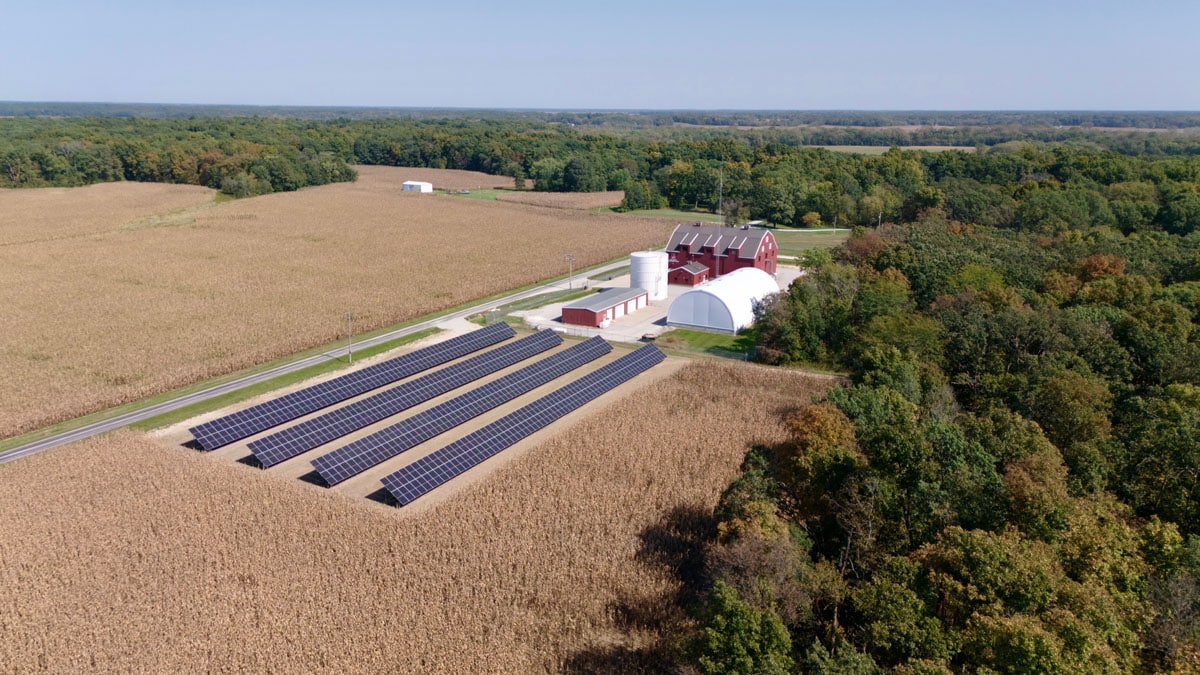
Illinois farm ground is among the most productive in the world, but when it comes to generating value per acre, solar energy can be an even more powerful crop. This case study explores a 291 kW (DC) ground-mounted solar array built for EJ Water Cooperative’s water treatment plant in Gila, Illinois. Installed on just 1.6 acres of farm ground, the project demonstrates how solar power delivers higher returns than traditional crops while also providing long-term sustainability benefits.
Project Overview
Client: EJ Water Cooperative – Gila Water Plant
Location: Newton, Illinois
System Size: 291.04 kW DC / 240 kW AC
Land Use: ~1.6 acres of farmland (formerly corn and soybean rotation)
On a 4-week timeline, Tick Tock Energy created a solar racking system consisting of steel poles attached to 124 73-inch helical steel screws that were drilled into the ground. A small excavator staged the racking material and solar panels, creating slight compaction. The solar array occupies about 250 by 280 feet of land (roughly 70,000 square feet). The panels themselves, with spacing between rows, cover 1.23 acres. Construction required minimal site disruption: the corn crop was mowed down with a bush hog before the racks were secured into the ground.
The system includes:
- 544 Panels: JA Solar JAM72 D30MB 535W Bi-Facial
- 4 Inverters: PVI-60TL-480 (1000V DC, 480V AC)
- Rack System: APA Ready Rack Ground Screw
Energy Production and Savings
The system is expected to generate about 423,000 kWh annually, reducing EJ Water’s electricity costs by approximately $17,000 in the first year. Factoring in a modest 5% annual inflation in energy costs, 15-year electricity savings could reach $332,000.
On a per-acre basis, the system delivers about $17,000 in value per acre in year one. For comparison, if an acre of farm ground generates 150 bushels of corn per acre that is sold at $4 per bushel, the value of corn would generate $600 in gross revenue. With more productive ground or higher corn prices, an acre of ground might produce upwards of $1000 to $1500 per acre for highly productive ground and strong commodity prices.
Solar clearly outpaces traditional farming with an 8-to-1 value ratio while avoiding the volatility and risks of commodity markets. After a farmer receives gross income, the high cost of seed, fertilizer, chemicals, diesel fuel, equipment, and land costs must be considered. After these additional factors, the resulting “net income” from farming pales in comparison to electricity production.
Additional Value Gained Through Incentives
Beyond electricity savings, the project also qualified for major incentives. Under the Illinois Shines program, the project sold its solar renewable energy credits (SRECs) to the State of Illinois. An SREC is equal to 1,000 kWh of solar production. The Illinois Shines program provides an incentive for 15 years of power production, with an SREC incentive paid out over 7 years. This payout adds approximately $271,000 in value. The project also qualified for a 40% direct-pay investment tax credit (ITC) through the federal government, further improving project economics.
With these additional incentives, EJ Water achieved a combined 15-year value of $603,000, averaging $40,200 per year. That equates to over $25,000 per acre annually during the first 15 years.
The Environmental and Agricultural Impact of EJ Water’s Solar Power System
The transition of 1.6 acres from farming to solar has minimal long-term impact, as the helical screws used to secure the system can be easily removed, leaving the soil nearly undisturbed. The overall estimated lifespan of the system is 30 years, but with proper maintenance and repairs, it could last much longer. The installed solar panels have a 25-year power warranty, and by year 30, the system should still provide about 80% of the nameplate power production.
Plus, each panel is constructed from glass, aluminum, and silicon, ensuring the system is non-toxic and easily recyclable. Tick Tock Energy has an active collection, storage and recycling policy for all broken or used solar panels, racking parts, and electronic parts found in inverters and other solar hardware.
While maintaining the ground beneath the solar panels could involve mowing, it could also be completed by sheep grazing. This up-and-coming option reduces mowing costs, generates additional revenue, and naturally fertilizes the soil. The area can also be used for low-growing native species that support bees and beneficial insects, which can positively impact the local ecosystem. This method can even improve nearby corn and soybean yields. Compared to continuous monocropping with herbicides and fertilizers, solar arrays can actually enrich soil quality over time.
System Life & Maintenance
- Panels: 30+ years, with 25-year performance warranty
- Inverters: 10–15 years (replaceable during system life)
- Racking: 30+ years, galvanized steel and aluminum
At the end of the design life, the system can be repowered with newer panels or safely removed with minimal environmental disturbance.
Achieve Significant Savings with Solar Power
This project illustrates how even a small commercial ground-mounted solar array can dramatically outperform farming in terms of per-acre value. For EJ Water Cooperative, the solar plant represents over $600,000 in combined energy savings and SREC income over 15 years, while preserving land for future use.
For farmers and commercial property owners in Illinois, solar represents a low-risk, high-reward investment that diversifies income streams, reduces operating costs, and enhances sustainability. To discuss your solar power options and create a system that meets your needs, contact Tick Tock Energy today.