Customer Story: Solar + Battery Helps Control Utility Rule Changes
When Tick Tock customer Wayne G. decided he was ready to go solar, the rules changed. Just as he began planning his project, Tri‑County Rural Electric Cooperative eliminated its net metering program. While neighboring Ameren customers could still offset their usage one‑for‑one, Wayne faced a very different reality: excess solar generation would be credited back at approximately 3 cents per kilowatt-hour (kWh). His retail rate he purchased electricity was closer to 12 cents per kWh. Instead of letting that stop him, Wayne asked a smarter question—how do I use as much of my own solar energy as possible?
The 2nd major realization Wayne learned is normal grid-tied solar arrays stop working when the grid is down. He wanted a system to operate during grid-outages and lower dependence on his existing Kohler propane-powered backup emergency generator which was costly to operate. Factoring generator maintenance and fuel it was estimated his generator provided emergency power at around 35 cents per kWh.
These questions turned out to be the beginning of a journey toward energy independence, resilience, and confidence—one that Tick Tock Energy was proud to help guide.
The Challenge Wayne Wanted to Solve
Wayne’s goals were clear from the start:
- Maximize the value of every kilowatt-hour (kWh) his solar system produced
- Reduce reliance on Tri‑County’s policies and rate changes
- Keep power on during outages, without relying solely on a generator
- Future-proof his home against rising electric costs and changing utility rules
Without net metering, exporting solar power back to the grid simply wasn’t acceptable. Batteries became the key—capturing solar energy during the day and using it when Wayne needed it most.
Building the Plan: Solar + Storage, Done Right
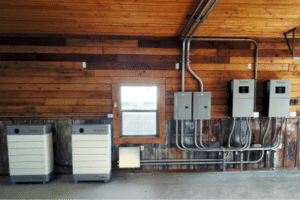
In 2021, Tick Tock Energy installed a 9.6 kW (DC) ground-mounted solar array featuring twenty-four (24) QCell solar panels. The array was paired with a Sol-Ark inverter with rated output of 9 kW (AC) and eight (8) Sol-Ark PCC-230 batteries. Each PCC battery is rated for 12 Volts, 230 Amp-hours (Ah) and offers 2.8 kWh of capacity per unit, providing 3000 cycles at 50% depth-of-discharge (DOD). The PCC chemistry is lead-acid (Partial Charge Carbon AGM). AGM means “absorbed glass matt” type which recharge faster than regular batteries and run similar to deep-cycle batteries. AGM type are common in solar battery energy storage (BESS) applications.
At the time, residential battery systems were in the earlier stage of adoption in Illinois, making Wayne in many ways a pioneer. From day one, Wayne didn’t just want solar power—he wanted control.
Wayne’s Ongoing Journey
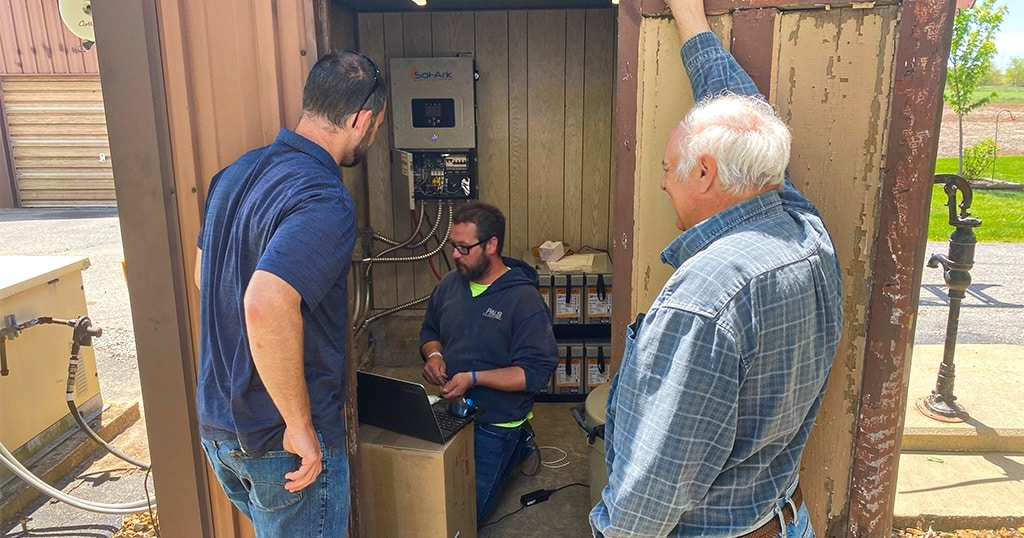
After a year of operation, he continued to carefully monitor his solar production, battery charge & discharge, his home’s electricity use, and system’s responseduring a grid outage. Working closely with Mark Holthaus, Tick Tock’s Service Department’s leader, Wayne fine-tuned inverter and battery setpoints to lean heavily on self-consumption. The goals were optimizing a balance between backup power and self-consumption leading to reduced generator runtime, minimize grid dependence, and protect himself from unfavorable utility economics. That collaboration—monitoring energy use, adjusting depth-of-discharge settings, and responding to real-world performance—was critical to dialing in the system.
One year in, Wayne & Mark confirmed a theory: more battery capacity would unlock even greater value.
Phase 2 Expansion: A Smart Adjustment, Not a Guess
In 2022, Wayne committed to expanding his energy storage system 50% and Tick Tock Energy installed four more batteries.
With the expanded storage, Wayne now:
- Covers nearly 100% of his electric needs in spring and fall
- Achieves near-zero utility usage for 3–4 months each year
- Uses stored solar energy well into the evening
- Maintains reserve capacity for unexpected outages
Barrier to Greater Self‑Consumption
During summer months, air conditioning remains the dominant load—and the biggest factor preventing year-round self-sufficiency. The system was not capable of supporting the startup amperage for his AC system. At Tick Tock’s suggestion, he added a soft-starter on his AC compressor. But, high on-going electricity draw was an unacceptable high drain on the batteries. The integrated Sol-Ark monitoring system allowed Wayne to study his consumption habits, solar output, battery status and ultimately fine tune his use of electricity and microgrid system. Wayne knows exactly where his energy goes—and why.
Today, with 12 batteries installed, Wayne feels he’s reached the “sweet spot.” Any further expansion would likely deliver diminishing returns—a conclusion he reached through real data, not guesswork.
The Outcome: Confidence, Control, and Peace of Mind
Ask Wayne how he feels about his system today, and the answer is simple: very happy.
He values the solar & battery monitoring tools, appreciates the ongoing support from Tick Tock Energy, and feels confident knowing he has both solar and storage working together as a system. More importantly, he feels protected—against outages, rising electricity prices, and utility rule changes beyond his control.
As Wayne put it, “At least now I feel like I have a chance.”
Final Word
Wayne G. didn’t go solar just to save money—he went solar to take control. By pairing solar generation with thoughtfully sized energy storage and hands-on support from Tick Tock Energy, he’s done exactly that.
For homeowners navigating changing utility policies, rising rates, and grid uncertainty, Wayne’s story shows what’s possible when you have a clear goal, a solid plan, and the right guide by your side.
Interested in exploring solar and battery storage for your business? Contact Tick Tock Energy to learn how a customized microgrid can help reduce costs, improve reliability, and keep operations running when the grid goes down.